
An equitable and just society
RUSTIC's vision is an equitable and just society facilitated through self-will and empowerment — a dignified and poverty-free society that makes no distinction of race, colour or creed.
RUSTIC began as a small group of activists in 1988 and grew into a registered, volunteer-driven development organization reaching more than 250,000 people across the south-west coast of Bangladesh.
Bangladesh is a developing country of over 148 million people; more than 47 million live below the poverty line, the most vulnerable among them women and children. The Khulna region — including Bagerhat — sits in the remote south-west, far from the economic centre of Dhaka.
The disaster-prone coast has endured at least five major natural disasters in the last fifteen years, among them Sidr, Aila, Amphan and Reshmi. Poor infrastructure, treacherous communication, and a wave of de-industrialisation — with at least 230 large and small industries closed in two decades — have left the region under-employed and fragile. COVID-19 made an already delicate situation harder still.
Even the interventions meant to help have had a price. The Coastal Embankment Project protected settlements but caused drainage congestion and water logging; shrimp cultivation has pushed salinity across agrarian land. And yet Khulna remains the country's second-largest sea port — a place of enormous possibility, waiting for the right course of action.
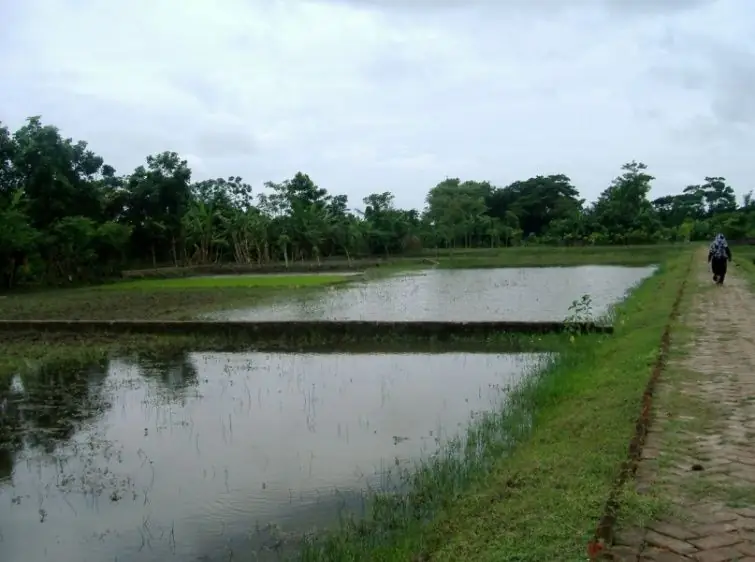
"Bangladesh is not a poor country by tradition — it is a treasure trove of agricultural resources. It is time to find an effective way to give hope for the survival and development of the left-out majority."
RUSTIC's vision is an equitable and just society facilitated through self-will and empowerment — a dignified and poverty-free society that makes no distinction of race, colour or creed.
"Poverty alleviation is well-known to the poor — only assistance is required." We mainstream sustainable development to the backward, deprived, vulnerable and affected men, women and children of the coast.
RUSTIC developed five strategic objectives to achieve its vision and materialize its mission. A two-fold strategy runs through all of them: building local institutions that speak for the poor, and delivering need-based resources and services.
Institutionalize grassroots people — from village groups to federations — so the poor, especially women, create a social and political space for themselves.
Equip the backward and deprived with literacy, skills and confidence to improve their own lives and their communities.
Help marginal farmers and the hardcore poor grow their own food and build livelihoods that withstand disaster and salinity.
Reduce carbon, protect biodiversity, and strengthen the coast's capacity to adapt to a changing climate.
Protect the rights and health of the poor — children, women, the elderly — where state services fall short.
At the micro level, institutions open social and political space for the poor. At the meso level, they act as district service institutions. At the macro level, they drive policy advocacy.
Moral Noor Mohammad and a group of social enthusiasts work as activists across the south-west coastal region — raising awareness, preparing action plans and supporting poverty-stricken communities.
The group formally emerges as RUSTIC — a voluntary social development organization for the helpless to establish themselves financially, socially and culturally.
Registered with the Directorate of Social Welfare, Government of Bangladesh, under No. Khulna-537/93.
RUSTIC starts the Community Based Municipal Solid Waste Management Project in Khulna City Corporation — collecting household garbage and producing organic fertilizer.
A new RUSTIC innovation recycles organic waste into fish feed and fertilizer, with support from BEMP and CIDA — protecting snail diversity and empowering women.
With the Ministry of Labour, RUSTIC launches non-formal education in Daulatpur, removing children from hazardous work — 720 students in two centres.
A new school and vocational centre opens for slum-dwelling adolescent girls threatened with social vulnerability.
SHGO begins supporting the girls' education project — building the school and providing educational and vocational equipment.
Under the RUWPP project funded by PKSF and the Bangladesh Climate Change Trust Fund, 120 families receive home-grown biogas plants.
Winrock International trains 32 youth in development, leadership and entrepreneurship — building RUSTIC's Youth Group of agricultural entrepreneurs.
RUSTIC unveils its new compost production plant at Shahpur Bazar, Dumuria — turning market waste into premium organic compost for the region.
From the freedom fighters who founded it to the field staff who walk every village today.
Meet our people